WebAssembly ABI
A service can be built to a WebAssembly module that the ankka runtime loads into its own process. The module owns decisions — given this command and this state, what should happen — and the runtime owns everything stateful and distributed: sharding, the journal, snapshots, projections, timers, HTTP, cluster formation, observability and the agent loop. It is the same division as a service in another language running as a process beside the runtime, and the runtime hosts both with the same code; what differs is how the two sides reach each other. A process speaks the protocol over gRPC; a module speaks the same messages across its own linear memory, through the exports and imports this page lists.
This page is for people writing or debugging a guest library. A service's own code never sees the ABI;
the library does. The Rust crate is one. The message definitions are in
protocol/src/main/protobuf/ankka/protocol/v1,
with this mode's envelopes in wasm.proto; the encoding of the bytes inside a payload is in
protocol/ENCODING.md, and
is the same in both modes.
Shape
A module is a WebAssembly core module (not a component). It imports functions only from the
module named ankka1, exports the functions below under the prefix ankka1_, and exports its
linear memory as memory. The 1 is the ABI's major version: the runtime refuses a module whose
ankka exports carry another number, naming both; a new major is a new prefix, and a runtime may
speak several.
Every value crossing the boundary is a protobuf message from protocol/src/main/protobuf, encoded
with the standard binary encoding. The Payloads inside them follow ENCODING.md unchanged.
Memory convention
Bytes cross as a pointer and a length into the guest's linear memory.
- Requests (host → guest): the host calls
ankka1_alloc(len) -> ptr, writes the request there, and calls the export with(ptr, len). The guest owns that buffer from then on and frees it. - Replies (guest → host): the export returns a
u64packingptr << 32 | len. The host readslenbytes atptrand then callsankka1_free(ptr, len). A zerou64is an empty reply. - Host imports that return bytes allocate through the guest's
ankka1_allocfrom inside the call, write, and return the same packedu64; the guest owns and frees the buffer. - The guest must not keep a pointer into a buffer it has freed, and the host never reads a buffer after freeing it. Alignment is not required.
Exports the guest provides
| export | in | out | notes |
|---|---|---|---|
ankka1_alloc(len: i32) -> i32 |
see memory | ||
ankka1_free(ptr: i32, len: i32) |
|||
ankka1_discover(ptr, len) -> i64 |
SidecarInfo |
WasmSpec |
once, at start |
ankka1_handle(ptr, len) -> i64 |
HandleRequest |
HandleReply |
entity and workflow commands |
ankka1_fold(ptr, len) -> i64 |
FoldRequest |
FoldReply |
replay: one journaled event applied to the state |
ankka1_run_step(ptr, len) -> i64 |
StepRequest |
StepReply |
workflow steps |
ankka1_close(ptr, len) |
Passivate |
stateful only; the guest drops the instance's state | |
ankka1_view(ptr, len) -> i64 |
ViewRequest |
ViewEffect |
|
ankka1_consumer(ptr, len) -> i64 |
ConsumerRequest |
ConsumerEffect |
|
ankka1_timed_action(ptr, len) -> i64 |
TimedActionRequest |
TimedActionEffect |
|
ankka1_plan(ptr, len) -> i64 |
PlanRequest |
PlanReply |
|
ankka1_invoke_tool(ptr, len) -> i64 |
ToolRequest |
ToolResult |
|
ankka1_check_guardrail(ptr, len) -> i64 |
GuardrailRequest |
GuardrailResult |
|
ankka1_check_task_result(ptr, len) -> i64 |
TaskResultRequest |
TaskResultVerdict |
an autonomous agent's result: decoded as its task type's, then held to the type's rules |
ankka1_http(ptr, len) -> i64 |
HttpRequest |
HttpReply |
non-streaming routes only |
_initialize() |
optional; called once per instance before any other export |
ankka1_alloc, ankka1_free, ankka1_discover and the memory export are required of every
module. The rest are required by what the module declares: ankka1_handle for any entity or
workflow, ankka1_fold for an event sourced entity, ankka1_run_step for a workflow, ankka1_close
for a component declared stateful, ankka1_view, ankka1_consumer and ankka1_timed_action for
those kinds, ankka1_plan for an agent (with ankka1_invoke_tool when it declares tools and
ankka1_check_guardrail when it declares guardrails), ankka1_check_task_result for an autonomous
agent (with the same two when it declares tools or guardrails), and ankka1_http for an endpoint. A module
missing one it needs is refused at start, naming the export and what needs it.
The host sets two kinds of metadata entry on every request that carries Metadata: ankka.now, the
runtime's clock as epoch milliseconds when it made the call, and the trace entries it sets for a
process. A module has no clock of its own: it asks for the time through the now import. ankka.now
is what a guest library from before protocol 1.10 reads, and the host goes on setting it on every such
request, so a module built with one still reads the time. A timed action's request also carries
ankka.timer, ankka.attempts and ankka.due, the due time the run is for, in epoch milliseconds as
ankka.now is. An entity or workflow command's metadata also
carries ankka.sequence, the journal sequence the state it is handed reflects. A consumer's request
carries ankka.sequence for the change it is handed and ankka.protocol, the protocol version the host
speaks. A guest answers produce_all, several messages for one change, only when that entry is 1.3 or
later, and fails the call otherwise, because an earlier host reads a reply it does not know as no effect;
see the sidecar protocol for the reply.
Imports the guest may use (module ankka1)
| import | in | out | semantics |
|---|---|---|---|
invoke(ptr, len) -> i64 |
InvokeRequest |
InvokeReply |
Client.Invoke; blocks the calling instance until answered |
invoke_stream(ptr, len) -> i64 |
InvokeRequest |
StreamTokens (the tokens collected; a streaming reply is delivered whole) |
|
query(ptr, len) -> i64 |
QueryRequest |
QueryReply |
|
schedule(ptr, len) -> i64 |
ScheduleRequest |
Empty |
|
cancel(ptr, len) -> i64 |
CancelRequest |
Empty |
cancels a timer of either kind |
schedule_recurring(ptr, len) -> i64 |
ScheduleRecurringRequest |
ScheduleRecurringReply |
a recurring timer, since protocol 1.12; a refusal is the reply's Error, not a trap |
await_end(ptr, len) -> i64 |
AwaitEndRequest |
InvokeReply |
Client.AwaitEnd: waits for a workflow's end, since protocol 1.18; blocks the calling instance for as long as the wait. A failure is the reply's Error, WORKFLOW_FAILED with details, not a trap |
config(ptr, len) -> i64 |
ConfigRequest |
ConfigReply |
a descriptor variable; reserved names answer absent, the service's secret key (ANKKA_SECRET_KEY) among them |
get_secret(ptr, len) -> i64 |
GetSecretRequest |
GetSecretReply |
the service's secret store, since protocol 1.6; blocks the calling instance |
put_secret(ptr, len) -> i64 |
PutSecretRequest |
PutSecretReply |
since 1.6 |
delete_secret(ptr, len) -> i64 |
DeleteSecretRequest |
DeleteSecretReply |
since 1.6 |
request(ptr, len) -> i64 |
ServiceRequest |
ServiceReply |
a call to another service, made by the runtime as this service, since protocol 1.10. Served only to the exports listed under Where request may be called; from any other, the call into the module ends there. Blocks the calling instance until the service answers or the runtime's wait for it ends |
now() -> i64 |
the runtime's clock as milliseconds since the Unix epoch, when it is asked; from any export, since 1.10 | ||
random(ptr, len) |
fills the len bytes at ptr, which the guest owns, from the runtime's secure source; len is at most 65,536; from any export, since 1.10 |
||
log(level: i32, ptr, len) |
UTF-8 text | to the runtime's log under the logger ankka.module; level is 0 trace, 1 debug, 2 info, 3 warn, 4 error (anything else is error) |
The secret imports and schedule_recurring answer every refusal in the reply's Error. A module that
never calls the secret store imports none of them, and one that never sets a recurring timer does not
import schedule_recurring, and one that never waits for a workflow does not import await_end, so it
runs on a runtime that predates them; the Rust crate calls them through
a function of their own for exactly that reason.
An import runs on the thread that called the export, which in the runtime is a virtual thread; a blocking import parks it and no other instance is affected. The guest may call an import only from inside an export.
Where request may be called
A call to another service waits for as long as that service takes, and a call into a module cannot be
interrupted. So the runtime serves request only to an export it runs on an instance of its own, where
the wait holds nothing another call needs. It decides from the export it called: it does not read the
request to decide, and it does not depend on what the guest library checks.
| Export | A request made while the runtime is running it |
|---|---|
ankka1_run_step |
proceeds |
ankka1_consumer |
proceeds |
ankka1_timed_action |
proceeds |
ankka1_plan |
proceeds |
ankka1_invoke_tool |
proceeds |
ankka1_check_guardrail |
proceeds |
ankka1_check_task_result |
proceeds |
ankka1_http |
proceeds |
ankka1_handle |
refused: a command of an entity or of a workflow, which every other command to the same instance would wait behind |
ankka1_fold |
refused: an event applied to an entity's state, which must give the same state every time |
ankka1_view |
refused: a view's handler, for the same reason |
ankka1_close, ankka1_discover |
refused |
A refused request does not return. The call into the module ends there, as it does for a trap: nothing
was sent, the instance is discarded and replaced, the state the runtime holds is untouched, and the
caller is answered with a fault that names the import and what was running, such as request may not be
called from the command cart/add-item. An export the ABI gains is refused until it is listed here.
A request is refused in the same way when the call it is made from has been abandoned. The module ran
past the runtime's deadline for the export, its caller has already been answered with a fault, and what
the module does after that makes no further call to another service.
request answers a ServiceReply with exactly one case set: response whenever the service answered,
whatever its status, a refusal included; failure when no answer came, with the reason UNRESOLVABLE,
IDENTITY_MISMATCH or UNANSWERED; and error when the runtime refused the request itself, such as a
name that is not one or a body over 4,000,000 bytes, or error with UNAVAILABLE before the service
has started. The runtime sends the metadata it gave the export being run, whatever
ServiceRequest.metadata holds, so the call is counted from that handler and traced under it. The request
carries no timeout: the runtime waits as long as the service's ankka.service-client.timeout says and
answers UNANSWERED when that passes. A redirect is the reply; it is not followed.
now is the time when it is asked. Two reads in one call may differ, and when an event is applied again
it is still the present, so an event's time is read from the event. random is never seeded and has no
setting; bytes used to make an id in a command belong in the event the command records, since applying
the event again does not run the command again. Neither waits, and both are served to every export.
A module that calls none of the three imports none of them, and runs on a runtime that predates them. A module that imports one is refused at start by an earlier runtime, naming the import.
Guest shapes
Declared per component in WasmSpec.stateful.
- Stateless (default): every
HandleRequest,FoldRequestandStepRequestcarriesstate(absent for a fresh, deleted or expired instance). The guest decodes it, acts, and returns the new state in the reply. It keeps nothing between calls. - Stateful: the host sends
stateon the first request afteropenand omits it thereafter; the guest keeps the decoded state for(component_id, entity_id)untilankka1_close. Every reply still carries the encoded state, so the host is never behind. A stateful component's instance is pinned to one guest instance for its loaded life.
Faults and refusals
- A refusal is a value:
Outcome.errorin a reply,ToolResult.error,GuardrailResult.block,HttpResponsewith an error status. Nothing is persisted; the caller sees the code. - A fault is a
failurefield set in a reply, or a trap (unreachable, out of bounds, out of memory, a panic underpanic = "abort"), or an import the host refused to serve: arequestfrom an export that may not make one, arandomfor more than it fills or into memory that is not the module's. The host discards the instance, keeps its held state, and answers the caller with a fault, as a process'sFailuredoes. - The guest should send a panic's message through
logbefore trapping, so the fault names itself.
Discovery
ankka1_discover receives SidecarInfo and answers WasmSpec. The runtime validates
WasmSpec.spec with the rules a process's Spec is held to and additionally refuses: a handler with streaming, a
streaming endpoint route, a socket route, a view's query declared watchable (a module reads a view whole, and
no import streams one), a stateful id that is not a declared stateful-kind component, and an
abi_version other than the exports' prefix. Every problem is reported at once in the runtime's
log; there is no ReportError call into a module.
The envelopes (wasm.proto)
| message | carries |
|---|---|
WasmSpec |
the process's Spec, the ids of the components declared stateful, and abi_version ("1") |
HandleRequest / HandleReply |
an entity or workflow command with the state the runtime holds, one oneof case per kind; the reply's state is the state after the command, and failure a fault |
FoldRequest / FoldReply |
one event applied to an event sourced entity's state, on replay and after a command's events persist; since protocol 1.19 it carries installation, where the event was written, and mirrored, true when that was another installation, since a module does not know where it runs |
StepRequest / StepReply |
a workflow step, with the state, answered with the step's effect and the state after it |
Passivate |
ankka1_close: the instance a stateful guest may drop |
ConfigRequest / ConfigReply |
the config import |
StreamTokens |
the invoke_stream import's reply, the tokens collected |
Versioning
WASM-ABI.md is versioned with the prefix. Within ankka1, an added export or import is a minor
change the runtime tolerates by absence (an optional export not present is not called; an import the
guest does not use is not needed). A changed signature or memory rule is ankka2_.
How the runtime hosts a module
The runtime reads the module once at start, compiles it once, and builds instances of it as it needs them.
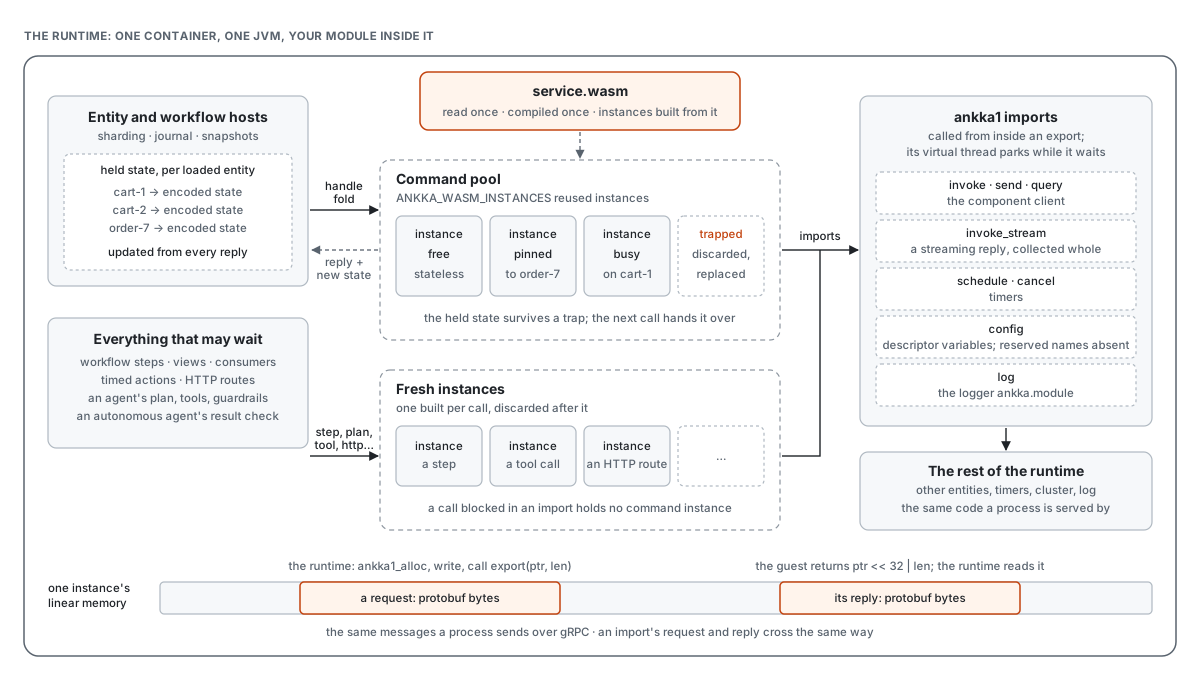
Two pools serve calls:
- Commands — entity and workflow commands, and replay — run on a fixed number of reused instances. A stateless component's command takes any free one; a stateful component's instance is pinned to one by its entity id, since that guest instance holds its state.
- Everything that may wait on the runtime — a workflow step, a view, a consumer, a timed action, an agent's plan, tool or guardrail, an autonomous agent's result check, an HTTP route — runs on a fresh instance built for the call and discarded after it, so a call blocked inside an import never holds an instance a command needs.
Every call runs on a virtual thread, so a guest blocked in an import parks that thread and nothing else. A call that does not return within the runtime's command timeout is abandoned: its instance is discarded and replaced, and the caller is answered with a fault.
The runtime holds each loaded instance's encoded state in both shapes, updated from every reply. That is what makes a fault cost nothing but the call that faulted: the instance is replaced, and the next call hands the state to whichever instance serves it.
Settings
The runtime image runs in this mode when ANKKA_WASM_MODULE names a file; on the platform the operator
sets it, and a descriptor may not set any of these.
| Variable | Default | Meaning |
|---|---|---|
ANKKA_WASM_MODULE |
none | The module to load. Absent, the image runs as a sidecar beside a process instead. |
ANKKA_WASM_INSTANCES |
the number of processors | How many reused instances serve commands; at least one. |
ANKKA_WASM_MAX_MEMORY_PAGES |
4096 |
The most linear memory an instance may grow to, in 64 KiB pages (256 MiB). |
Environment
A module has no environment of its own. The config import answers the variables the service's
descriptor set, read from the runtime's environment, and answers absent for every name the platform
reserves: model keys and settings (ANTHROPIC_*, ANKKA_MODEL_*), the database's (ANKKA_DB_*), the
cluster's and the runtime's own (ANKKA_CLUSTER_*, ANKKA_WASM_*, ANKKA_SIDECAR_*, ANKKA_PROCESS_*,
ANKKA_AUTH_*), POD_IP, ANKKA_HTTP_PORT, ANKKA_BASE_DOMAIN and ANKKA_HTTPS_PORT.